

Transposing a chord chart is one rule applied consistently: count the distance in semitones between the old key and the new one, then move every chord in the chart by that same distance. The chord qualities never change. Only the roots move.
Somebody in the band asks for it every few rehearsals — the singer is straining on the chorus, or the chart came in a key nobody wants to play. Here’s how to do it in a couple of minutes, and how to stop having to do it at all.
Step 1: count the semitones
Everything runs on the chromatic scale — twelve semitones, then it repeats:
C → C♯/D♭ → D → D♯/E♭ → E → F → F♯/G♭ → G → G♯/A♭ → A → A♯/B♭ → B → C
Note where the half steps live: there’s no black key between E and F or between B and C. Those two pairs are one semitone apart, everything else on the white keys is two. Miscounting there is the single most common transposing error.
To go from A to C: A → A♯ (1) → B (2) → C (3). Three semitones up.
Step 2: move every chord by that interval
Apply the same shift to each root and leave the quality alone:
| Chart in A | Shift | Chart in C |
|---|---|---|
| A | +3 | C |
| F♯m | +3 | Am |
| D | +3 | F |
| E | +3 | G |
| Bm7 | +3 | Dm7 |
| D/F♯ | +3 | F/A |
Three things to keep straight while you work:
- Quality is untouched. Minor stays minor, 7 stays 7, sus4 stays sus4.
- Slash chords move on both sides. D/F♯ up three semitones is F/A — the bass note transposes too.
- The interval is fixed for the whole chart. If one chord moves up three semitones, all of them do. A chart with one chord left behind is worse than no chart.
Step 3: fix the spelling
The pitch is right, the name might not be. Every key has a correct set of accidentals, and you want the one that keeps the chart readable.
Take a real case. Here’s a chart in G♭ major — six flats, which is fine for the piano and rough on everyone reading letters:
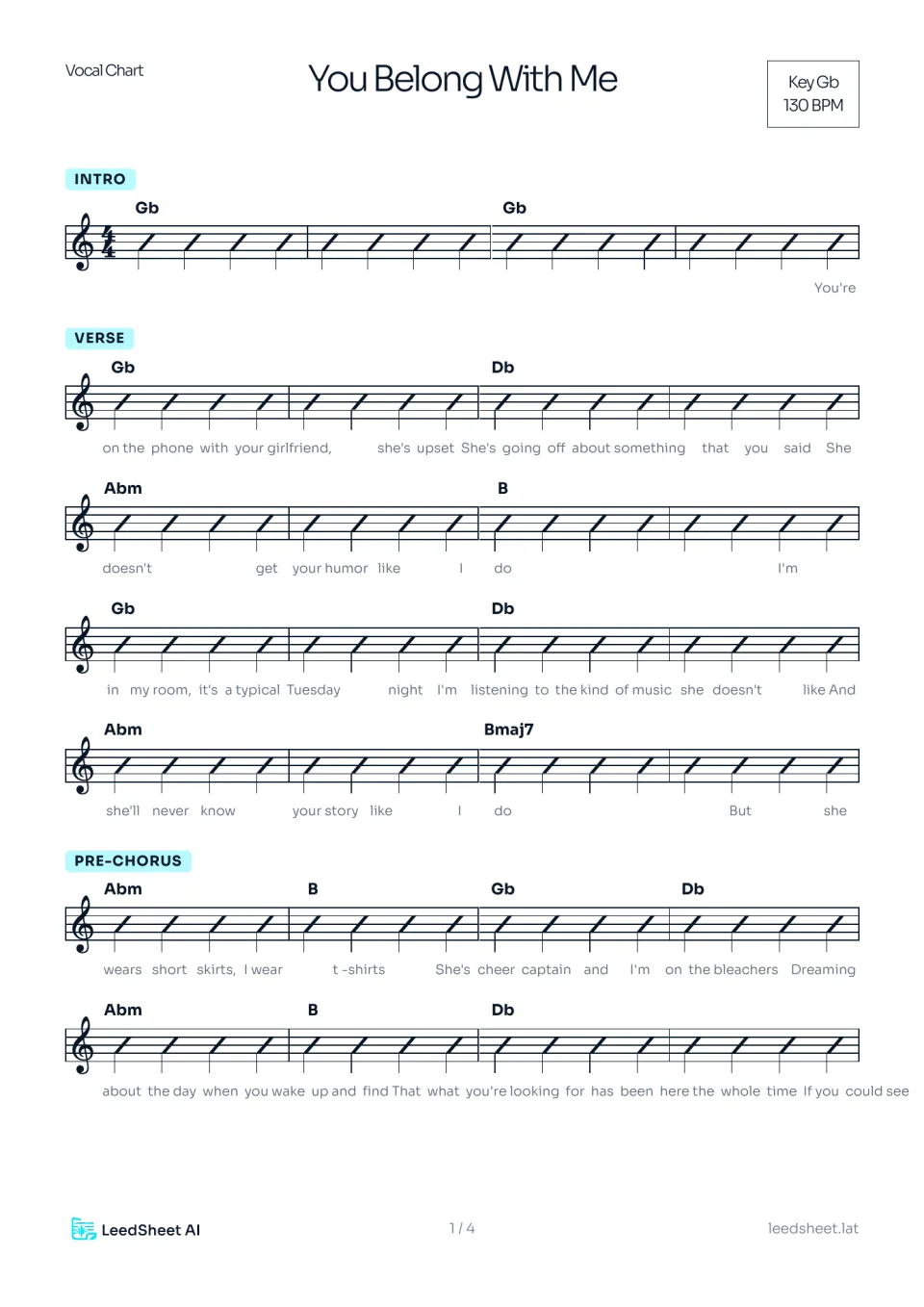
Move it up one semitone and the whole page gets easier: G♭ → G, D♭ → D, A♭m → Am, B → C, Bmaj7 → Cmaj7.
Look at that fourth one. The chart writes B where G♭ major technically wants C♭ — same pitch, friendlier name. That’s the spelling decision in miniature: notate for the person reading at rehearsal, not for the theory exam. The general rule is that sharp keys (G, D, A, E) take sharps and flat keys (F, B♭, E♭, A♭) take flats, and you break it when breaking it is clearly more readable.
The capo shortcut (guitar only)
A capo raises every string by one semitone per fret, so you keep playing shapes you know while the song sounds higher.
| You want to sound in | Play shapes in | Capo at |
|---|---|---|
| A | G | 2 |
| B♭ | G | 3 |
| B | A | 2 |
| C | G | 5 |
| D | C | 2 |
| E♭ | C | 3 |
| F | E | 1 |
| F | D | 3 |
Two limits worth knowing before you rely on it. A capo only goes up — to sound lower you have to genuinely transpose. And it solves the problem for one guitarist: the bass player, the keys player and anyone reading the chart still need the real chords, so the chart itself should be written at concert pitch with the capo position noted.
The method that skips transposing entirely
If your keys change often — a worship team adapting to whoever is leading, a session where the artist decides the key on the day — the fastest transposition is the one you never do.
Write the chart in numbers instead of letters. 1, 4, 5, 6m describe the harmony relative to whatever key you’re in, so one page works in all twelve. The singer moves the song up a step and nobody rewrites anything; the band reads the same numbers and plays different chords.
That’s the Nashville Number System, and it’s the standard answer in exactly the settings where transposing is a weekly chore.
Choosing the key, not just changing it
Transposing is mechanical. Picking the target key is a judgment call, and it comes down to three things:
- The singer’s range. Find the melody’s highest and lowest notes and move the chart until both sit comfortably inside the voice. The top of the chorus decides this, not the verse.
- What the instruments want. Guitars like E, A, D, G. Horns like flat keys. Six sharps makes everyone slower.
- The character of the key. Open strings ring in E and A and go quiet in E♭. Moving a song two semitones can cost the guitar part its shimmer, which is sometimes worth a compromise on range.
Horn players read transposed parts on top of all this: a B♭ trumpet or tenor sax part is written a whole step above concert pitch, and an E♭ alto sax part a major sixth above. If you’re writing for horns, transpose the part, not just the chart.
Getting the original key right in the first place
All of this assumes you know the key you’re starting from — and half the charts floating around the internet are in a different key from the recording the band is actually learning.
Transcribing from the audio settles it. AI chord chart transcription analyzes the recording and reports the chords, measures, key and BPM together, so the chart you transpose matches the record.
LeedSheet does this on macOS — import the audio, generate the chart, edit and export. It also generates Nashville number charts, which is the version you hand the band when the key is still up for discussion.