

A lead sheet is a one-page score that carries the essentials of a song and nothing else: the melody on a staff, the chord symbols above it, and the lyrics underneath. Everything about how the song gets played — voicings, rhythm, instrumentation, dynamics — is left to whoever is holding the page.
That restraint is the whole point. A full arrangement tells five musicians exactly what to play. A lead sheet tells them what the song is, and trusts them to make an arrangement out of it on the spot.
What goes on a lead sheet
Every usable lead sheet carries six things:
- The melody, notated on a single staff in the song’s key.
- Chord symbols above the staff (C, Am7, F♯m, B♭maj7), placed where the harmony changes.
- The lyrics, aligned under the notes they’re sung on.
- Key signature and time signature, at the start of the first system.
- A tempo marking, in BPM or as a feel (“ballad”, “medium swing”).
- Section labels and repeats — intro, verse, chorus, bridge, D.C. al Coda — that tell you the form.
Anything beyond that is arrangement, and it belongs on a different piece of paper.
Lead sheet vs chord chart vs sheet music
The three formats sit on a scale from “least written down” to “most”:
| Chord chart | Lead sheet | Full sheet music | |
|---|---|---|---|
| Chord symbols | Yes | Yes | Sometimes |
| Melody notated | No | Yes | Yes |
| Lyrics | Often | Usually | Yes |
| Every part written out | No | No | Yes |
| Length | 1–2 pages | 1–2 pages | Many pages |
| Reading skill | Chord symbols | Basic notation | Fluent notation |
| Who uses it | Rhythm sections, bands, worship teams | Vocalists, soloists, jazz players | Orchestras, choirs, students |
If you only need to settle which chords, in what order, for how long, a chord chart is enough — we cover that split in detail in chord chart vs lead sheet. The moment somebody has to sing or play a melody they don’t already know, you need the melody on the page, and a chord chart can’t give you that.
What a real chart looks like
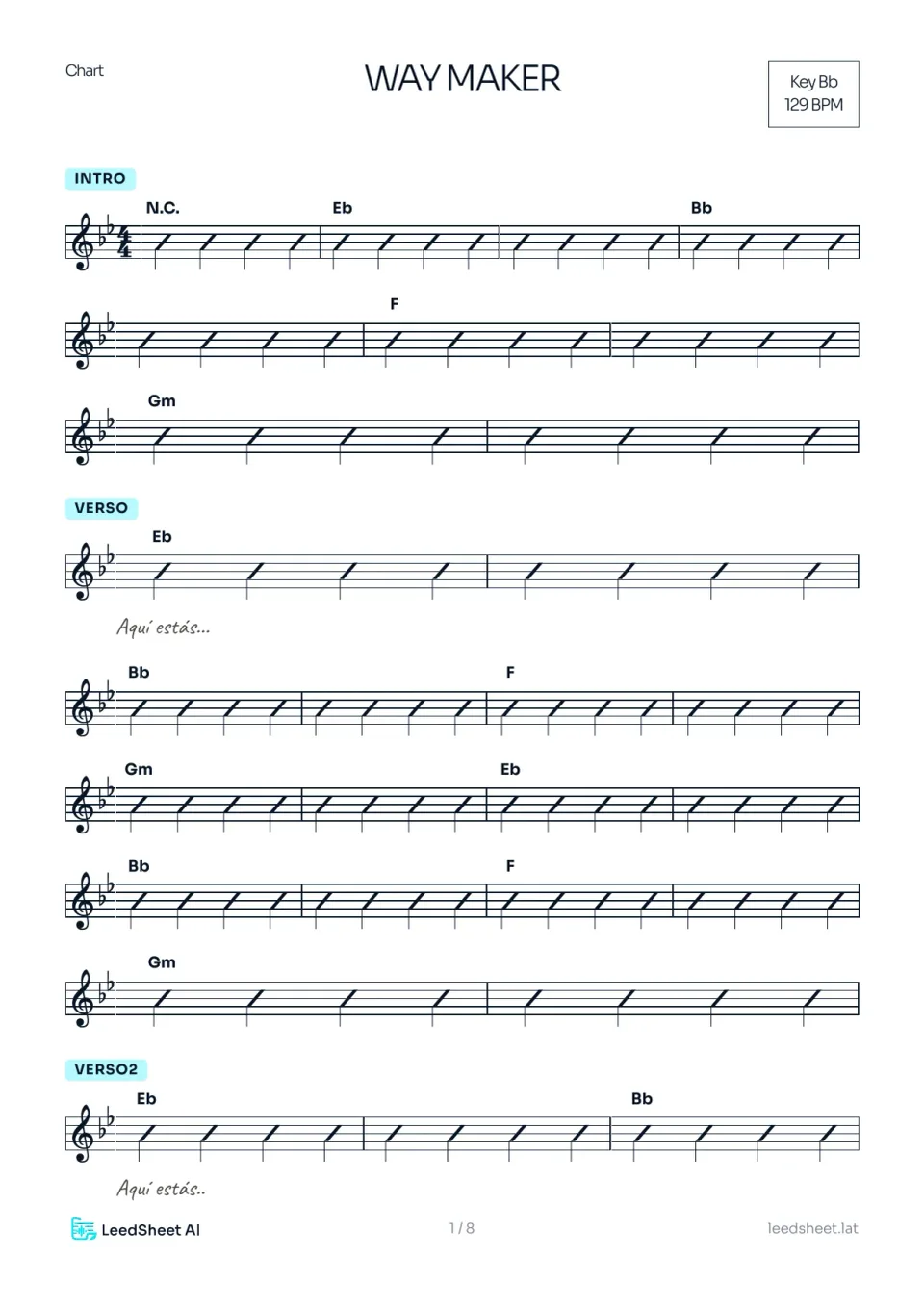
Note what the header does. Key and BPM sit in the top-right corner because they are the first two questions anyone asks, and neither should require reading the first bar to answer.
When you actually need a lead sheet
- A vocalist is learning a song they’ve never sung. They need the melodic shape, not just the harmony under it.
- A sub is covering a gig. Hand a horn player a lead sheet and they can play the head cold.
- You’re playing jazz standards. The entire fake-book tradition is lead sheets — melody, changes, form, one page.
- You wrote the song. A lead sheet is the standard way to register, pitch and hand off an original.
And when you don’t: if the band already knows the tune and the argument is about the key or the form, a chord chart is faster to read and faster to make.
Why one page matters
The one-page constraint isn’t nostalgia for paper. A chart that fits on a stand is a chart nobody has to turn mid-song. Fake books have kept the format for eighty years for exactly that reason, and the constraint survives on tablets: one page means one glance, and the drummer’s eyes stay off the screen.
The way you fit a song onto one page is repeats and section labels, not a smaller font. Write the chorus once and send the reader back to it.
How to make a lead sheet from a recording
The traditional path is transcription: sit with the recording, find the key, work out the chords, notate the melody by ear. It works, and for one song it takes anywhere from thirty minutes to an afternoon.
The shortcut is to let a model do the listening pass:
- Import the audio. Any file works — a demo, a rehearsal recording, a released track.
- Generate the chart with AI. In one pass you get the chord progression, measures, key and BPM. See how AI chord chart transcription works for what the model is actually doing.
- Review and correct. Dense mixes and unusual voicings are where errors cluster. You’re editing a draft, not writing one.
- Label the sections and export. Intro, verse, chorus, bridge — then a PDF for the stand.
LeedSheet does this on macOS: import audio, generate the chart, edit and export. It is completely free, with unlimited charts and every feature included.
Four mistakes that make a lead sheet unusable
- No key or tempo in the header. Two facts, and leaving them out costs the band the first two minutes of rehearsal.
- Chords floating over lyrics instead of over measures. That tells you the order of the chords but not how long each one lasts — so the bass player guesses.
- Unlabelled sections. A band leader calls “back to the bridge” mid-song. The chart needs a bridge to point at.
- Writing every note the record plays. That’s an arrangement. Lead sheets carry the song, not the recording of it.