

Musicians use the two terms loosely, and most of the time that’s fine — until you ask someone to bring “the chart” and half the band shows up with something different. The distinction is simple:
A chord chart shows the harmony and the structure. A lead sheet adds the melody.
What a chord chart is
A chord chart lays out the chord progression over measures, usually with section labels (intro, verse, chorus, bridge), the key and the tempo. There’s no melody notation — it assumes you know how the song goes and tells you what to play under it. It’s the working document of rhythm sections everywhere: guitarists, bassists, keys players and drummers reading structure.
What a lead sheet is
A lead sheet includes everything a chord chart has, plus the melody written on a staff (and often the lyrics under it) — see what is a lead sheet for the full anatomy. It’s the standard format of jazz fake books and of any situation where someone needs to sing or play the tune without having memorized it — a sub covering a gig, a vocalist learning a new song, a horn player reading the head.
Side by side
| Chord chart | Lead sheet | |
|---|---|---|
| Harmony (chords) | Yes | Yes |
| Song structure | Yes | Yes |
| Melody on a staff | No | Yes |
| Lyrics | Often | Usually |
| Reading skill needed | Chord symbols only | Basic notation |
| Time to produce | Minutes | Longer — the melody has to be notated |
| Typical users | Rhythm section, bands, worship teams | Vocalists, soloists, jazz players |
What a chord chart looks like on the stand
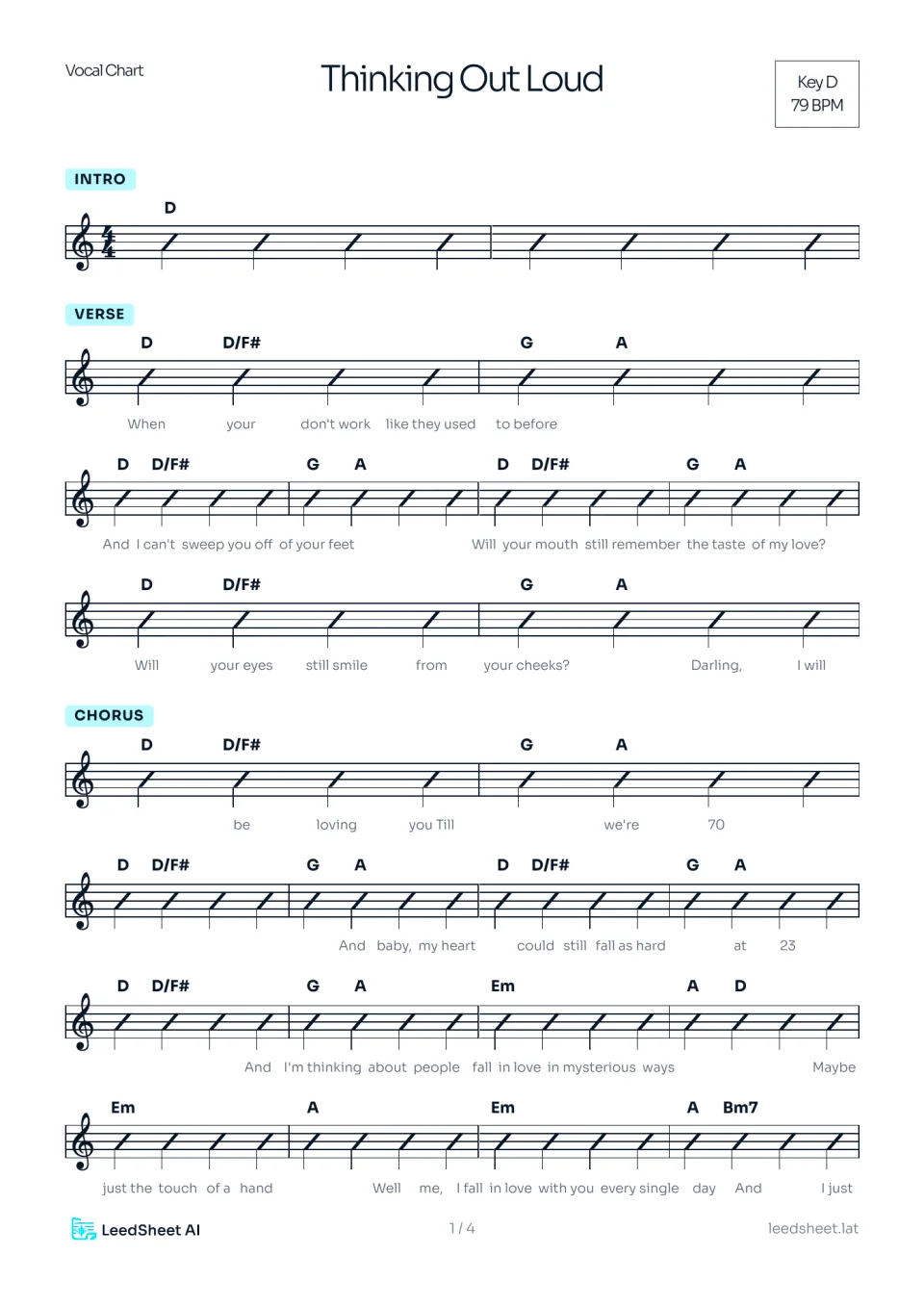
Three things in that image do the actual work. The key and BPM in the header, because those are the first two questions anyone asks. The bar lines, because a chord floating over a lyric tells you the order but not the duration — bars tell the bass player when to move. And the section labels, because a band leader calls “back to the chorus” mid-song and the chart has to have a chorus to point at.
Which one do you need?
- Your band already knows the song and needs everyone playing the same structure in the same key → chord chart.
- Someone has to perform a melody they don’t know → lead sheet.
- You’re building a set list for rehearsal → chord charts for the set, lead sheets only where a melody must be read.
Concretely, by situation:
| Situation | Format | Why |
|---|---|---|
| Sunday worship set, band knows the songs | Chord chart | Everyone needs form and key, nobody is reading a melody |
| Vocalist learning a song this week | Lead sheet | The melodic shape is the thing they don’t have |
| Jazz gig from a fake book | Lead sheet | Head, changes and form on one page is the tradition |
| Depping for a guitarist tonight | Chord chart | You need to comp correctly, not sing |
| Pitching an original you wrote | Lead sheet | The standard way to hand off a song |
| Rehearsing an arrangement you already play | Chord chart | Faster to read, faster to change |
When a chord chart quietly isn’t enough
The failure mode is predictable: the band nails the form and the vocalist is a semitone off in the pre-chorus, because nothing on the page ever told them what the melody does there. If more than one person in the room is guessing at the tune rather than the harmony, you needed the melody notated, and no amount of tidying the chord chart fixes it.
The inverse mistake is cheaper but more common: producing a full lead sheet for a song the band has played forty times. Notating a melody nobody reads costs you an hour and gives the rhythm section a busier page to scan.
What makes a good chart of either kind
The format matters less than whether the chart is actually usable on a stand at rehearsal. Four things separate a chart people can play from a chart people argue over:
- The key, stated up front. It’s the first question anyone asks, and the answer shouldn’t require reading the first bar.
- The tempo in BPM. Non-negotiable if you play to a click or run tracks, and useful even if you don’t.
- Chords sitting over real measures. Chords floating above lyrics tell you the order but not the duration. Bars tell the bass player when to move.
- Named sections. Intro, verse, chorus, bridge, outro. A band leader calls “back to the chorus” mid-song — the chart has to have a chorus to point at.
Where the Nashville Number System fits
You’ll also run into charts written in numbers instead of letters: 1, 4, 5, 6m rather than C, F, G, Am. The Nashville Number System notates the harmony relative to the key, so a single chart works in any key — the singer moves it up a step and nobody rewrites anything.
It’s a notation choice, not a third format: a Nashville chart is still a chord chart, just written in scale degrees — the notation is covered in full in the Nashville Number System, and if you’d rather move a letter chart by hand, see how to transpose a chord chart. It shines in sessions and worship settings where keys change to fit a vocalist, and it costs you the ability to hand the chart to someone who reads letters and expects to play immediately.
Creating either from audio in seconds
The traditional bottleneck is the same for both formats: someone has to sit down and transcribe the song. That part is now automated — AI chord chart transcription takes an audio file and returns the progression, measures, key and BPM as an editable chart.
LeedSheet does exactly this on macOS: import audio, generate the chart with AI, then edit sections and export. It is completely free, with unlimited charts and every feature included.
Frequently asked questions
What is the difference between a chord chart and a lead sheet?
A chord chart shows the harmony and the structure — chord symbols over measures, section labels, key and tempo. A lead sheet has all of that plus the melody on a staff, usually with lyrics underneath. If nobody has to read a melody they don’t already know, a chord chart is enough.
Is a lead sheet the same as sheet music?
No. Full sheet music notates every note every instrument plays, across many pages. A lead sheet notates the melody and the chord symbols on one or two pages and leaves voicings, rhythm and instrumentation to the performer.
Which format do bands and worship teams use?
Chord charts, almost always. The rhythm section needs the progression, the form and the key, and everyone already knows how the melody goes. Lead sheets appear when a vocalist is learning a song cold or a sub has to play a melody they’ve never heard.
Is a Nashville number chart a third format?
No — it’s a notation choice inside the chord chart format. Scale degrees (1, 4, 5, 6m) instead of letters, so one page works in any key. Still no melody on a staff, so still a chord chart.