

The Nashville Number System writes chords as scale degrees instead of letter names: 1, 4, 5, 6m rather than C, F, G, Am. Because every number is relative to whatever key you’re in, one page works in all twelve — the singer moves the song up a step and nobody rewrites anything.
It came out of Nashville session work in the late 1950s, where the same players cut several songs a day and the artist’s key was often decided in the room. It has since become standard wherever keys move: sessions, country and pop tracking dates, and most worship teams.
The numbers, in any major key
Build a chord on each degree of the major scale and the qualities come out in a fixed pattern:
| Number | Quality | In C | In G | In B |
|---|---|---|---|---|
| 1 | major | C | G | B |
| 2m | minor | Dm | Am | C♯m |
| 3m | minor | Em | Bm | D♯m |
| 4 | major | F | C | E |
| 5 | major | G | D | F♯ |
| 6m | minor | Am | Em | G♯m |
| 7dim | diminished | Bdim | F♯dim | A♯dim |
Memorize one row and you can read any chart: 1, 4 and 5 are major; 2, 3 and 6 are minor; 7 is diminished and rarely shows up. Anything that breaks the pattern gets marked explicitly — a 4m in a major key, a ♭7, a 3 played major as a secondary dominant.
Why the letters get in the way
Here’s a chart in B major — five sharps:
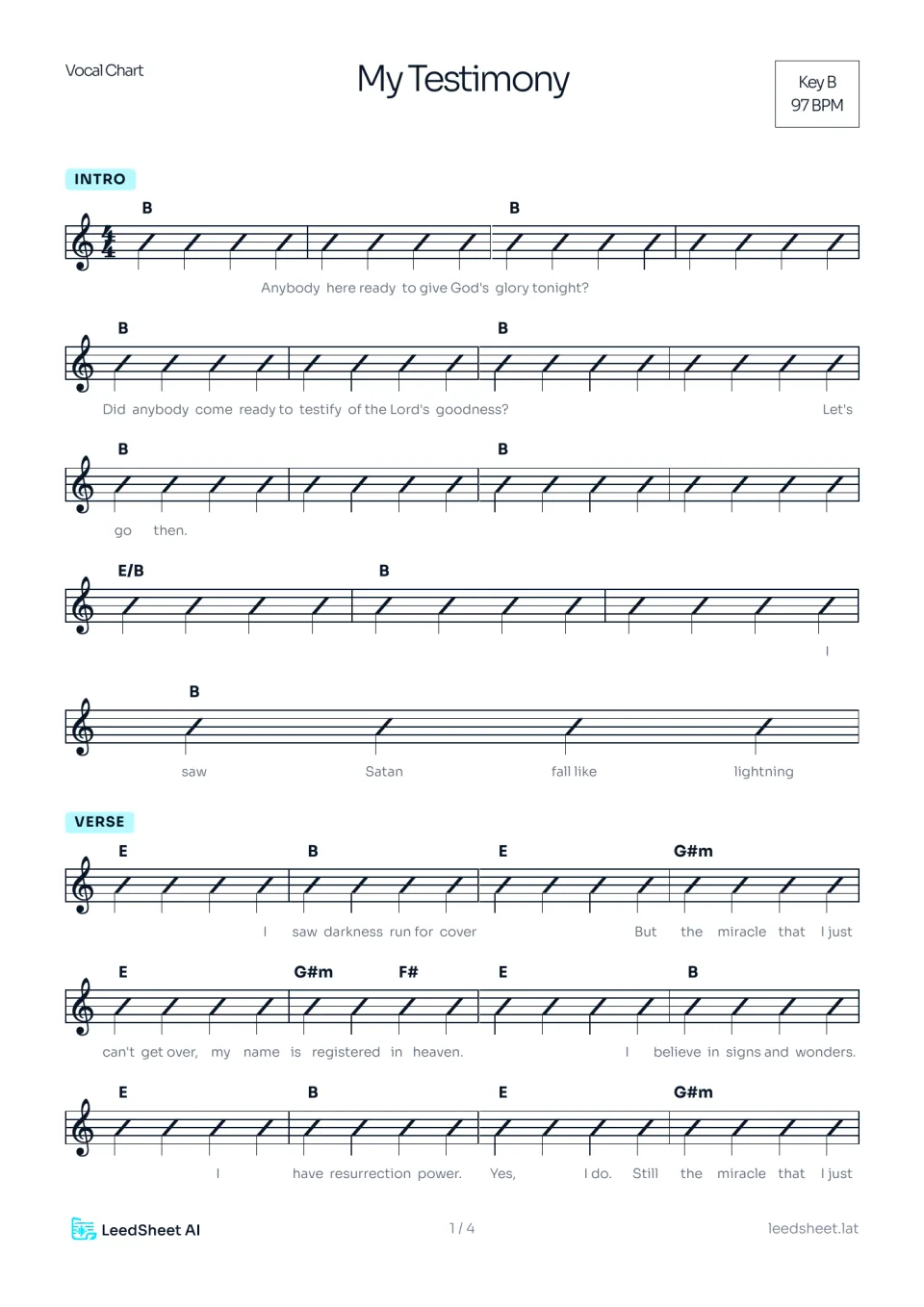
Reading that in letters, the verse is B, E, G♯m, F♯. Reading it in numbers, it’s 1, 4, 6m, 5 — a shape most players recognize instantly. And when the vocalist asks for it a step lower, the letter chart needs rewriting while the number chart doesn’t change at all.
That’s the trade in one sentence: numbers cost you instant readability for a player who thinks in letters, and buy you a chart that survives every key change.
Notation you’ll see on a number chart
Conventions vary between writers, but these are near-universal:
- Bars. Numbers are grouped by measure, usually separated by spaces or bar lines:
| 1 | 4 | 6m | 5 |is one chord per bar. - Split bars. Two chords in one measure are joined with an underline or written together:
1 4under a single bar means two beats each. - Diamonds. A number inside a diamond ◇ is held — hit it and let it ring instead of playing time.
- Minor.
6mor6−. Both are read the same way. - Slash chords.
1/3means the 1 chord over the third degree in the bass — C/E in the key of C, B/D♯ in B. - Pushes. A caret or angle before a number (
>4) means anticipate it by an eighth note, landing ahead of the beat. - Extensions. Written after the number exactly as they’d be after a letter:
5sus4,2m7,1maj7. - Modal borrowings. Flats and sharps sit in front:
♭7in the key of C is B♭, a chord that isn’t in the major scale but shows up constantly.
The chart still needs a header with the key, the tempo and the time signature. A number chart without a key at the top is unplayable — which is the system’s one real weakness and the reason the key gets written in a box, large, before anything else.
Where it earns its keep
- Sessions. The artist decides the key when they arrive, the band reads the same chart either way.
- Worship teams. Rotating vocalists means rotating keys. A number chart per song outlives every roster change.
- Bands with subs. A sub who reads numbers can play a set they’ve never seen without asking anyone to transpose.
- Songwriting. Progressions are easier to compare, reuse and talk about as numbers — 1-5-6m-4 is a conversation, C-G-Am-F is a specific instance of it.
Where letters still win
- One-off charts in a fixed key. If the key will never move, letters are faster to read and need no mental translation.
- Players who don’t use the system. Hand a number chart to someone who reads letters and you’ve made their night harder, not easier.
- Heavily arranged material. Dense reharmonization with constant modulation is where numbers start costing more than they save.
A practical compromise: keep the number chart as the master and export letters for whoever needs them for a specific gig.
Getting to a number chart faster
Writing one by hand means transcribing the song, identifying the key, and converting every chord to a degree — an extra pass on top of the transcription itself.
LeedSheet generates Nashville charts directly from audio on macOS: import the recording, and the AI returns the chords, measures, key and BPM, with a Nashville chart as one of the three formats it produces. It is completely free, with unlimited Nashville, regular and vocal charts.
If you want the underlying mechanics first, start with how AI chord chart transcription works.